
Commercial Waste Manor Park: Recycling & Sustainability
Commercial Waste Manor Park is committed to creating an eco-friendly waste disposal area and a sustainable rubbish area that serves local businesses across the borough. Our approach combines practical on-site separation, partnerships with reuse organisations, and a low-carbon logistics plan to reduce landfill dependency and maximise resource recovery. By aligning with the borough's waste separation strategy and promoting circular economy principles, Manor Park commercial waste services aim to set a new standard for urban sustainability.
Our Sustainability Commitment and Recycling Target
We have set a clear recycling percentage target: 70% recycling rate by 2030 across all collected streams for commercial premises in Manor Park. This goal reflects ambitious but achievable reductions in residual waste as we ramp up separate collections for organics, paper and card, glass, plastics and metals. Through operational improvements and customer engagement, we will steadily increase the diversion of materials from disposal to recovery and reuse. Tracking progress quarterly ensures transparency and continuous improvement.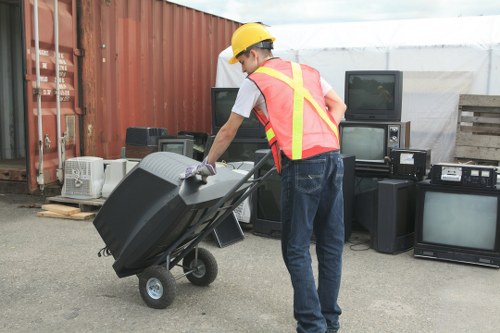 To support local infrastructure we work closely with transfer stations and consolidation points across the east London area. Commercial waste in Manor Park is regularly routed to nearby transfer stations that process commercial recyclables before they head to material recovery facilities or reprocessing centres. The borough's pragmatic approach to waste separation—encouraging separate food caddies, dry mixed recycling and clear glass streams—means our collection routes are optimised to deliver cleaner, higher-value recyclate to the right destinations.
Practical Initiatives and Service Features
Our sustainable rubbish area offers a range of services designed to make recycling straightforward for businesses. Key initiatives include:- On-site segregation bays for cardboard, plastics and glass to reduce contamination.
- Dedicated food waste collections to support anaerobic digestion and composting.
- Return-to-supplier schemes and compactors to improve transport efficiency.
- Waste audits and reporting to measure diversion against the recycling percentage target.
- Community reuse channels that prevent usable items from being disposed of.
 The borough and local stakeholders have encouraged a layered approach to separation: businesses are asked to segregate organics, dry recycling and residuals at source, with clearly labelled containers and visual prompts in communal areas. This reduces contamination, increases the yield of marketable materials and supports the wider Newham and neighbouring boroughs' policies on circular waste management. For Manor Park commercial waste customers, this means clearer guidance on what goes where and more reliable recovery outcomes.
Partnerships play a central role in making the sustainable rubbish area truly circular. We coordinate with local charities and social enterprises to redirect reusable goods such as furniture, office equipment and textiles. Instead of routing these items to disposal, our reuse partners enable them to find new homes, support local employment and provide affordable items to community members. Strong links with food redistribution groups also ensure surplus edible goods avoid landfill when possible.
An important pillar of our low-impact strategy is transport decarbonisation. Our fleet for Manor Park commercial collections increasingly features low-carbon vans, including electric vehicles and hybrids for urban rounds, plus efficient Euro 6 vehicles where appropriate. We aim to transition to 100% low-emission vans by 2028 for short-haul collections, complemented by cargo bikes for dense streets and pedestrianised areas. These measures cut local emissions, noise and congestion while maintaining reliable collections for businesses.
 Operational logistics are focused on minimising handling and maximising consolidation. Collected material is taken to local transfer stations and quality-controlled before onward movement to recycling facilities or reprocessors. By coordinating flows with neighbouring borough transfer points and regional consolidation hubs, we reduce unnecessary vehicle miles and keep processing chains efficient. This regional coordination also supports higher recycling quality and helps reach the 70% recycling target by ensuring correct routing of separated streams.
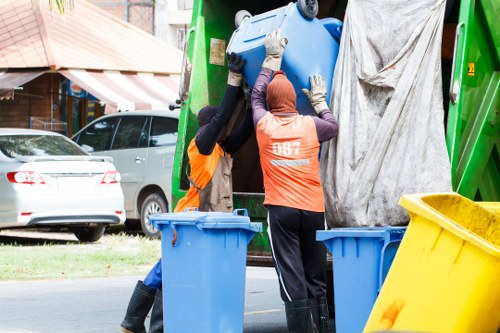 In summary, Manor Park commercial waste services provide a resilient, sustainable rubbish area for businesses looking to reduce environmental impact. Through clear separation aligned with borough policies, partnerships with reuse charities and social enterprises, use of local transfer stations and an expanding fleet of low-carbon vans, we are transforming how commercial waste is handled in the area. Our vision is a cleaner, greener Manor Park where commercial recycling is the norm and resource loops are closed as far as possible—supporting both local economic resilience and long-term environmental goals.
